Dinosaurs / Troodontids
Anchiornis
Dinosaur Middle JurassicLate Jurassic
Anchiornis was a troodontid that lived in the Middle Jurassic and Late Jurassic, 168 to 152 million years ago.
- Mass
- 0.7 kg
- Lived
- 168 to 152 million years ago
- Fossil finds
- 3

The size of Anchiornis
Its body mass is estimated at 0.7 kg (1.5 lb).
Mass: Benson and others, body mass data, CC0, read 2026-11-15.
Name
Name and family
The genus was named by Xu et al. in 2009.
Its one listed species is Anchiornis huxleyi.
It is classed as a carnivore, omnivore, a diet the database records for Troodontidae as a whole.
It is one of 35 troodontids in the Paleobiology Database.
Family tree
- Averostra
- Tetanurae
- Coelurosauria
- Maniraptora
- Paraves
- Deinonychosauria
- Troodontidae
- Anchiornis
Fossils
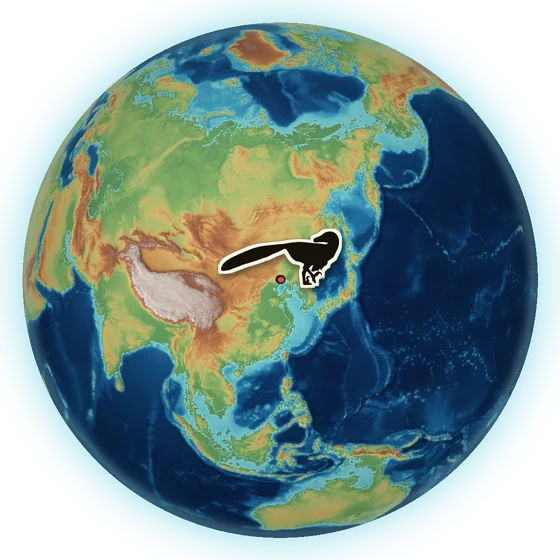
Where Anchiornis has been found
Three fossil finds of Anchiornis are recorded, in China.
All of the finds with a named rock unit come from the Tiaojishan Formation.
On the atlas's maps its finds appear at 160 million years ago.
Rock formations Tiaojishan Formation3
Neighbours
Its world
Its closest relative in this atlas is Sinusonasus.
Found in the same rocks
 DarwinopterusLong-tailed pterosaurs
- KunpengopterusLong-tailed pterosaurs
- JeholopterusLong-tailed pterosaurs
- PterorhynchusLong-tailed pterosaurs
- TianyulongEarly bird-hipped dinosaurs
- ArchaeoistiodactylusPteranodonts
- XiaotingiaTroodontids
Closest relatives
Sources
Fossil records were read from the Paleobiology Database on 2026-11-16. Anchiornis in the Paleobiology Database (CC0).
Ancient map: Scotese and Wright 2018, PALEOMAP PaleoDEMs, doi:10.5281/zenodo.5460860, CC BY 4.0, redrawn as shaded relief.
Outline: Velociraptor mongoliensis by Richard Rich, PhyloPic, CC0.
The size drawing uses the outline of Velociraptor mongoliensis, standing in as a general troodontid shape; no openly licensed outline of Anchiornis in a pose that can be measured was found.